
Mélanie Fauteux is a clinical nurse specialized in wound, ostomy and continence care (NSWOC) at CISSS de Chaudière-Appalaches, where she has practiced at the complex wound care clinic of Hôtel-Dieu de Lévis since 2009. She holds a Bachelor of Nursing from the Université du Québec en Outaouais and has been NSWOC-certified since 2011. She is recognized for her expertise in the assessment and management of complex clinical cases. She also serves as an academic advisor within the NSWOC program, contributing to the education of future clinicians and to the continuous improvement of the curriculum. An active speaker at regional and national events, Mélanie shares evidence-based practices with a wide range of healthcare professionals. Committed to innovation and interdisciplinary collaboration, she works to optimize care pathways and support patient and caregiver autonomy. Ms. Fauteux is a paid consultant for Solventum.
Fauteux_Current-Dialogues-in-Wound-Management_2026_Article-7
Negative pressure wound therapy (NPWT) is used to promote the healing of complex wounds through, reduction of interstitial edema, improved tissue perfusion, promotion of granulation tissue development and exudate management.1,2 Use of NPWT is particularly useful for deep tissue loss, when damage extends to underlying structures, and when the healing process requires wound bed preparation before skin grafting can occur.1,3
Despite its well-established effectiveness, Solvetnum™ V.A.C.® Therapy with Solvetnum™ V.A.C.® Granufoam™ Dressing has limitations. Application requires several technical steps, and dressing changes must be performed every two to three days depending on the clinical situation. In some circumstances, particularly when multiple wounds or fragile periwound skin are present, these requirements may represent a significant challenge for both patients and healthcare professionals.1
In our institution, V.A.C.® Therapy with V.A.C.® Granufoam™ Dressings has been used as a bolster for more than 15 years to promote adherence of split-thickness skin grafts. Typically applied at -75 mmHg, V.A.C.® Therapy, when used as a bolster over grafts, remains in place for five days or up to seven days when available resources are limited to change the dressing at 5 days.
In our experience, application of V.A.C.® Therapy with V.A.C.® Granufoam™ Dressings over a skin graft generally requires between 15 and 30 minutes in the operating room. The technique includes protection of the periwound skin, cutting and shaping wound interfaces and foam dressings, application of an adhesive drape, and creating an opening for and placement of the Solventum™ SensaT.R.A.C.™ Pad. Achieving an adequate seal can sometimes be challenging.
Over the years, we have observed several technical errors associated with application of V.A.C.® Therapy that could compromise graft outcomes. These included omission of the protective interface, inadequate protection of the periwound skin, and skin injuries resulting from the absence of protective material beneath a foam bridge. In our setting, application of V.A.C.® Therapy is often performed by the surgeon with assistance from operating room staff. Frequent staff turnover and the relatively low volume of these procedures make it difficult to maintain consistent expertise.
The Solventum™ V.A.C.® Peel and Place Dressing provides an opportunity to simplify the application technique by integrating several steps into a single application, while preserving the benefits traditionally associated with V.A.C.® Therapy, namely graft stabilization, exudate management, graft protection, and protection of the periwound skin through its integrated interface.1,3 We gradually incorporated use of V.A.C.® Therapy using V.A.C.® Peel and Place Dressing into our practice to evaluate its impact on quality of care, patient comfort, and ease of use for clinicians.
Use of the Solventum V.A.C.® Peel and Place Dressing for Skin Graft Fixation
Three patients (two males, one female, age range 65-71 years old) requiring skin grafting were selected for use of V.A.C.® Therapy with V.A.C.® Peel and Place Dressing. Patient medical condition included scar calcification of the right thorax (n=1), inflammatory retiform purpura of the left knee (n=1), and nodular basal cell carcinoma of the right pretibial region (n=1). Split-thickness skin graft (STSG) sizes were 312 cm2, 84 cm2, and 30 cm2. A large V.A.C.® Peel and Place Dressing was used for the 312 cm2 STSG, while a medium sized V.A.C.® Peel and Place Dressing was used for the remaining two patients.
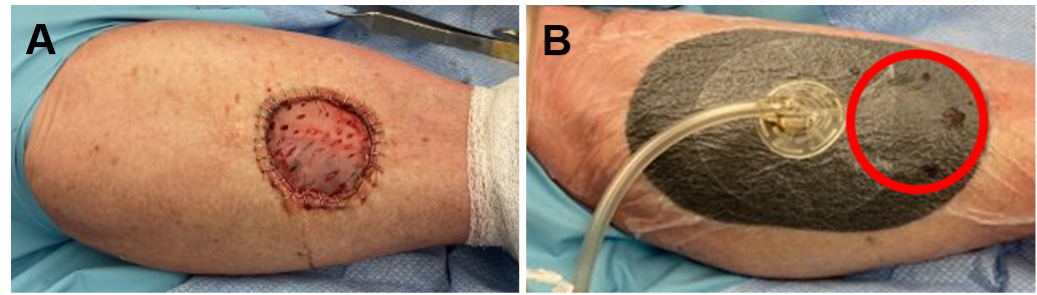
Application of the V.A.C.® Peel and Place Dressing took three minutes to complete. V.A.C.® Therapy using -75 mmHg pressure was initiated (Figure 1). Dressings remained in place for 5-6 days. At the first STSG evaluation, graft takes from 90%-100% were observed (Figure 2A). V.A.C.® Therapy was discontinued and the graft covered with a non-adherent, paraffin-impregnated dressing containing 0.5% chlorhexidine, gauze, and secured with self-adhesive medical tape or self-adherent gauze bandage. Dressings were changed daily for the first week, then every 2-3 days until complete healing had occurred. At the second follow-up visit (16-22 days after grafting), 100% graft take was observed for all 3 patients (Figure 2B).
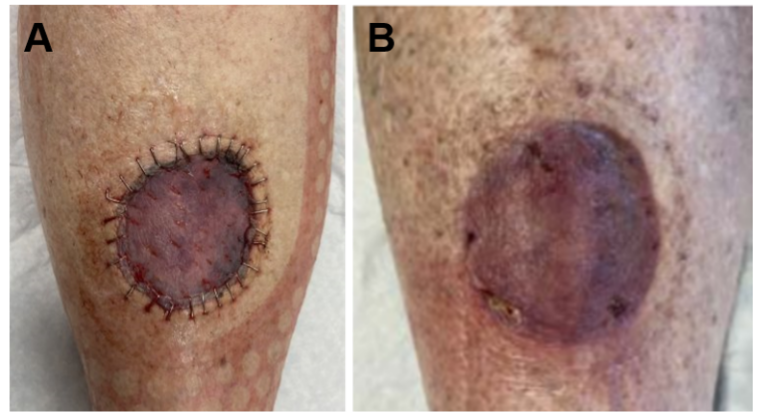
In all three cases, the V.A.C.® Peel and Place Dressing proved simpler and faster to apply than the conventional technique and required less training to apply. Clinical teams rapidly became comfortable with the method, and achieving an effective seal was easier. We also observed a reduction in operative time and, consequently, a shorter duration of exposure to anesthesia. The outcomes obtained were comparable to those observed with V.A.C.® Therapy using conventional dressings. The grafts demonstrated good adherence, and exudate management was satisfactory. The ability to leave the dressing in place for five to seven days without additional intervention was also appreciated.
However, we observed small, localized tissue deformation directly beneath the Solventum™ SensaT.R.A.C.™ Pad in some patients. These findings may have been related to the limited thickness of the reticulated open cell foam in that area. The tissue deformations remained minor, never compromised graft take or the healing process, and resolved without requiring any additional intervention once therapy was discontinued. Based on this experience, it may be beneficial to use a larger dressing whenever possible in order to position the SensaT.R.A.C. Pad farther away from the grafted area.
Our experience demonstrated that the benefits of the V.A.C.® Peel and Place Dressing extends beyond simplifying the management of complex wounds and may also contribute to simplifying a well-established surgical procedure.4
Conclusion
In our experience, V.A.C.® Peel and Place dressing simplified care, decreased the time and training required for dressing application and changes, and improved comfort for both patients and clinicians. Although these observations are limited to a small number of cases, they suggest that this technology may represent a valuable option when the complexity of conventional NPWT application or the fragility of the periwound skin constitute significant barriers to optimizing care.
References
-
Bobbink P, Paquet F, Probst S. Thérapie par pression négative. In: Reeves I, Chaplain V, éditeurs. Pratiques exemplaires en soins des plaies: de novice à expert. Tome 1. Québec: Presses de l’Université Laval; 2023. p. 985-1019.
-
Young S, Hampton S, Martin R. Non-invasive assessment of negative pressure wound therapy using high frequency diagnostic ultrasound: oedema reduction and new tissue accumulation. Int Wound J. 2013;10(2):204-209.
-
Cardin-Langlois E, Reeves I, Chaplain V. Chirurgie reconstructrice. In: Reeves I, Chaplain V, éditeurs. Pratiques exemplaires en soins des plaies : de novice à expert. Tome 2. Québec: Presses de l’Université Laval; 2023. p. 215-243.
-
Fauteux M. Gestion post-opératoire des greffes de peau avec la thérapie par pression négative (TPN) : comparaison entre la TPN classique et un nouveau pansement pour TPN prêt à l’emploi [poster]. Conférence nationale de l’Association canadienne des infirmières spécialisées en plaies, stomies et continence (NSWOC); 2024; Montréal, QC, Canada.